Strikeouts#
The strikeout is baseball’s most symbolic out. Three strikes and you’re done — but how you got there matters enough to record differently depending on whether the batter went down swinging or stood there watching strike three go past.
K and the Backwards K#
K is the universal symbol for a strikeout. It dates to the 1860s, when Henry Chadwick (the father of baseball statistics) chose K because “struck” — the root of “strikeout” — ends in K. S was already taken for sacrifice.
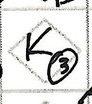
- K — strikeout swinging. The batter swung at strike three and missed.
- Backwards K (Ꝁ) — strikeout looking (called). Strike three was called by the umpire; the batter did not swing. Some scorekeepers write this as Kc instead.
The backwards K has become iconic in baseball culture. Fan sections hang backwards K signs for each strikeout by a dominant pitcher, counting them across the outfield wall. It’s a mirror letter for a batter who didn’t move — who stood frozen while the pitcher made them look foolish.
Here’s a hand-scored strikeout cell — a clean K with the out number circled below it. Simple, unmistakable, and used essentially unchanged since the 1860s.
BaseballScorer uses the backwards K for called strikeouts — the mirror-image letter that’s become iconic in baseball culture.
Color Coding#
Strikeout text is rendered in red on the scorecard. This makes strikeouts visually pop when scanning the grid — you can quickly see how many Ks a pitcher racked up without reading every cell. The red text stands out against the otherwise neutral scorecard, giving you an instant read on a pitcher’s dominance.
Dropped Third Strike#
Here’s a wrinkle: a strikeout is not always an out.
If the catcher fails to catch strike three cleanly — the ball bounces away — the batter may attempt to run to first base, provided first base is unoccupied or there are two outs. The catcher must then throw to first (or tag the batter) to retire the batter, just like any other ground ball.
This rule opens up six different scoring notations — K-WP, K-PB, K 2-3, K 2T, K E2, K E3 — covering the cases where the batter reaches base on a wild pitch, on a passed ball, on a catcher’s error, on a first baseman’s error, or is retired by the catcher’s throw or tag.
The pitcher always gets credit for the strikeout regardless of which variant. What changes is whether the out is recorded and which fielder (if any) is charged with an error or credited with the putout.
For the rule mechanics, all six notations explained, and how each variant affects pitcher IP and the earned-runs calculation, see Dropped Third Strike.
Strikeout Double Plays#
A strikeout can be part of a double play in rare situations. The most common: bases loaded, batter strikes out on a wild pitch, catcher picks it up and throws home to get the runner from third who broke for the plate. Score it K, WP, 2-5-3 or similar, depending on the exact sequence.
These are unusual enough that you may never see one in a season of casual scoring. But if it happens, record the strikeout first and then the subsequent fielding sequence.
In BaseballScorer#
With pitch tracking on: BaseballScorer detects strikeouts automatically. As you record each pitch, the count updates in real time. When the third strike is recorded — whether swinging or looking — BaseballScorer recognizes the at-bat is complete.
If the final pitch was a swinging strike, the outcome is recorded as K. If you mark the pitch as “called strike,” it becomes a backwards K.
For a dropped third strike, long-press the Called Strike or Swinging Strike button instead of tapping; a menu lets you pick any of the six variants (K-WP, K-PB, K 2-3, K 2T, K E2, K E3). See Dropped Third Strike for the full flow.
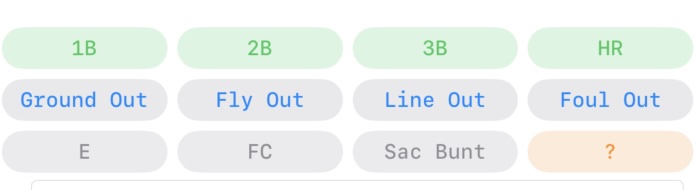
Without pitch tracking (manual entry): Tap K (swinging) or Ꝁ (looking) directly in the outcome button grid. The at-bat closes immediately. Long-press either button to open the dropped-third-strike menu if the play needs one of the six D3K variants.
The scorecard cell shows the K or backwards K notation in red text. If pitch dots are enabled, you’ll see the sequence of pitches that led to the strikeout.